Anakron Living History once again had the opportunity to bring the medieval period to the public during Mellieħa Nights 2026, one of the locality’s largest annual cultural events organised by the Mellieħa Local Council.
Held between 24 and 26 July 2026, Mellieħa Nights brought together local organisations, performers, artists and members of the community for several evenings dedicated to Maltese culture, history and entertainment.
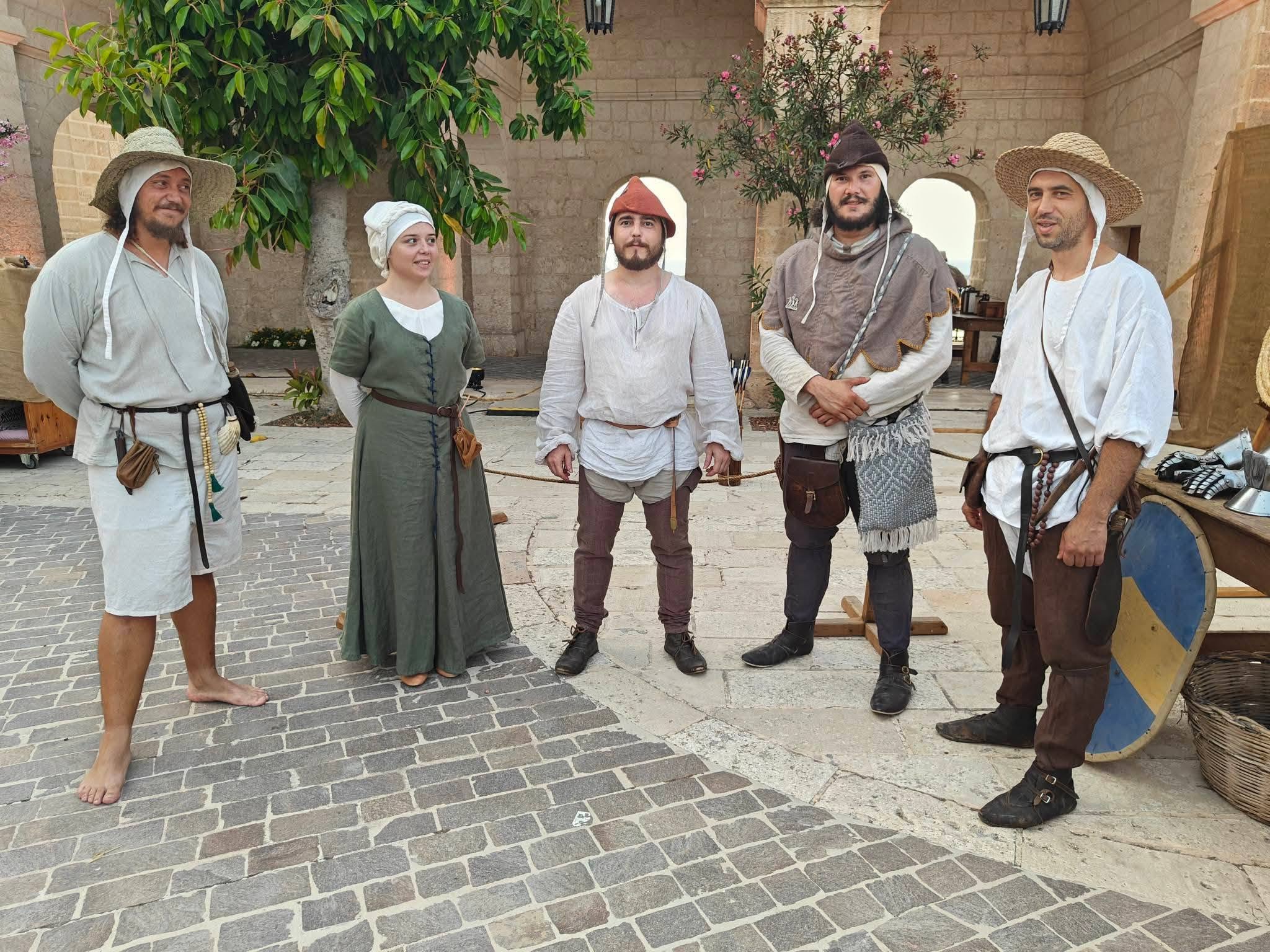
As part of the programme, Anakron presented a medieval living-history exhibition, giving visitors the opportunity to encounter aspects of life from the medieval period within the lively surroundings of Mellieħa.
For Anakron, participating in public events such as Mellieħa Nights provides an important opportunity to introduce living history to people who may never previously have encountered historical re-enactment.
Rather than presenting history solely through written information or objects placed behind glass, our displays aim to place historical equipment back into the context in which it would once have been used.
Throughout the evening, visitors were able to meet Anakron participants dressed in historically inspired clothing and explore a selection of objects representing both the civilian and military sides of medieval life.
Armour and Weaponry
An important part of the exhibition was our display of medieval armour, weapons and military equipment.
Visitors were able to observe reproductions of equipment associated with soldiers and armed men during the medieval period and learn more about the purpose and construction of the different pieces.
The display provided an opportunity to explain that medieval military equipment developed considerably over time. Armour, weapons and fighting techniques were influenced by changing technology, available materials and the different roles performed by soldiers on the battlefield.
Rather than simply displaying swords and armour as decorative objects, Anakron participants were able to discuss how such equipment would actually have been worn, carried and maintained by the people who depended upon it.
This interaction is an important part of living history. Being able to see the scale, weight and construction of historical equipment helps visitors appreciate aspects of medieval life that can sometimes be difficult to understand from photographs or books alone.
More Than Knights and Battles
Although medieval warfare is often one of the first things people associate with the Middle Ages, Anakron has always aimed to show that medieval society consisted of far more than soldiers and knights.
The civilian side of living history is therefore equally important to our interpretation.
Through historically inspired clothing, equipment and everyday objects, our displays help introduce visitors to the people who formed the majority of medieval society, craftsmen, labourers, farmers, traders and families whose lives continued far away from the battlefield.
These individuals were responsible for producing food, maintaining settlements, manufacturing goods and providing the many skills and services upon which medieval communities depended.
Showing both the civilian and military aspects of the period allows us to present a more complete picture of medieval life.
Bringing History Into the Community
One of the most rewarding aspects of Mellieħa Nights was the opportunity to speak directly with members of the public.
Visitors of different ages stopped at the Anakron exhibition to examine the displays, ask questions and learn more about medieval history.
Children in particular often approach living-history displays with curiosity, especially when they are able to see historical objects at close range and speak directly with the people interpreting them.
These conversations are precisely why public events are so valuable to Anakron.
Living history becomes particularly effective when visitors are encouraged to ask questions rather than simply observe. A discussion about a piece of armour, an item of clothing or an everyday object can lead to much broader conversations about how people lived hundreds of years ago.
Representing Anakron and the Selmun Project
Our participation at Mellieħa Nights also gave us another opportunity to speak about Anakron's ongoing work at Selmun.
Anakron is currently developing the Selmun Interpretation Centre into an immersive historical environment inspired by a 15th-century medieval village.
The project is being developed gradually through the voluntary work of the foundation's participants, who contribute their time and skills towards maintaining the site and creating historically inspired spaces in which different aspects of medieval life can eventually be demonstrated.
While events such as Mellieħa Nights allow us to take a small part of our interpretation into the wider community, Selmun provides us with the opportunity to develop these ideas on a much larger scale.
The long-term objective is to create a place where visitors can walk through different areas of a medieval settlement and encounter history being interpreted around them.
Supporting Local Heritage
Taking part in Mellieħa Nights was particularly meaningful because of the relationship Anakron has developed with the Mellieħa community through our activities at Selmun.
Cultural events provide an important opportunity for local organisations to work together and contribute different aspects of Maltese heritage to a shared programme.
For Anakron, this means using living history to help make the medieval period accessible, engaging and memorable.
Each public event gives us the opportunity to meet new people, share what we have learned through historical research and encourage further interest in Malta's medieval past.
We would like to thank the Mellieħa Local Council for including Anakron Living History in Mellieħa Nights 2026 and for continuing to support cultural and historical activities within the locality.
We would also like to thank everyone who visited our exhibition, spoke with our participants and showed an interest in medieval history and in the work being carried out at Selmun.
Events such as Mellieħa Nights remind us that history does not need to remain confined to books and museums.
Through living history, it can once again become something that people can encounter, discuss and experience together.
26 July 2026
Anakron at Mellieħa Nights 2026
Anakron joined Mellieħa Nights 2026 with a medieval living-history exhibition featuring period clothing, armour, weapons and historical displays for visitors to explore.