Food and Cooking in Medieval Malta
What surviving evidence tells us about ingredients, cooking and the medieval Maltese table
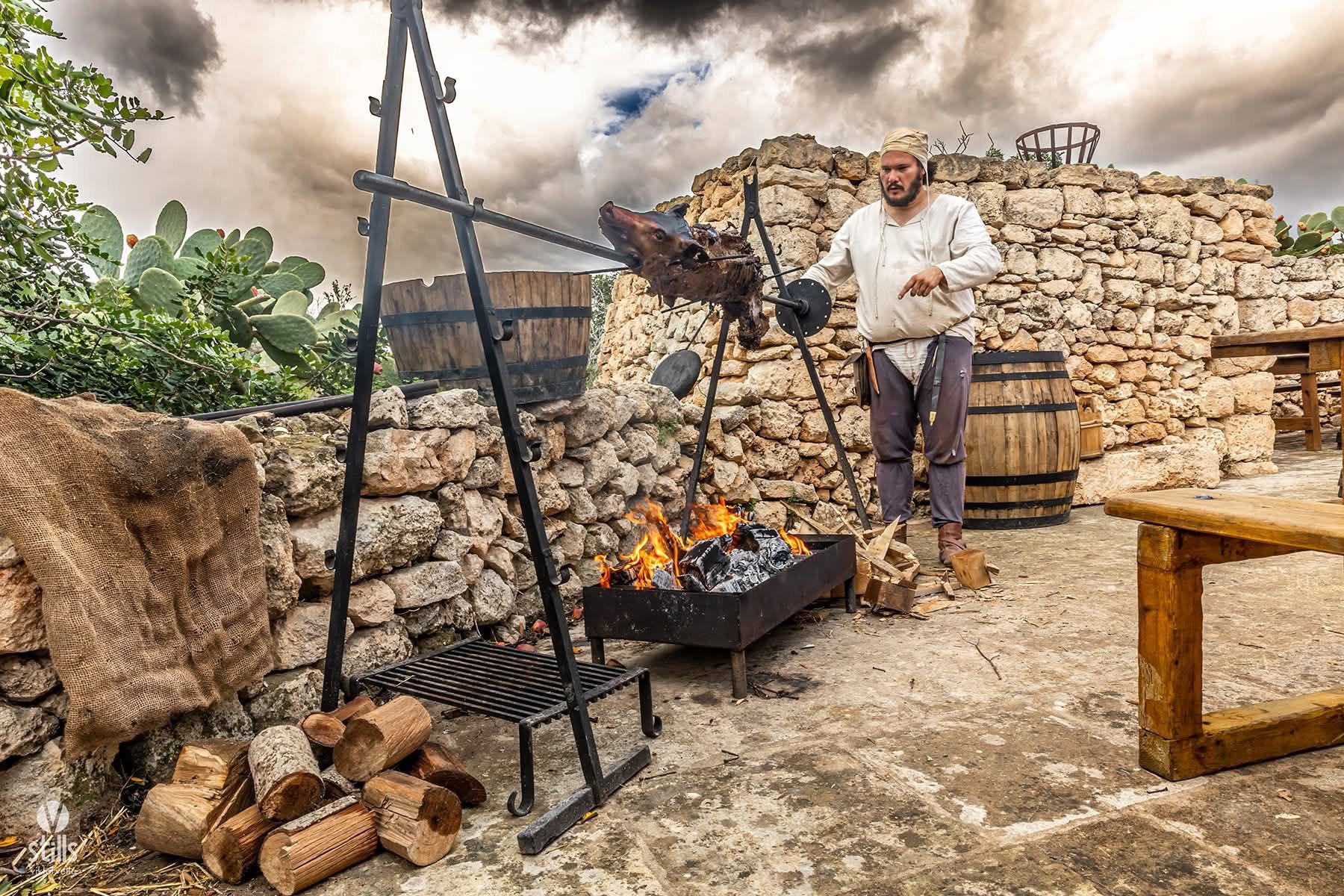
Reconstructing a medieval Maltese kitchen
Reconstructing medieval food involves more than reproducing recipes. Historians and living-history groups also consider the ingredients available, the equipment used to prepare them, the methods of cooking and the wider economy that supplied the food.
Evidence for everyday meals in medieval Malta is incomplete. Surviving documentary records tell us about agriculture, livestock, imported grain and certain foodstuffs, while archaeological and wider Mediterranean evidence helps us understand cooking equipment and preparation methods.
Anakron's living-history displays use this evidence to create an interpretation of a working medieval food-preparation area. It should not be understood as an exact reconstruction of one particular Maltese kitchen, but as an evidence-informed representation of the practices of the period.
Cooking with fire
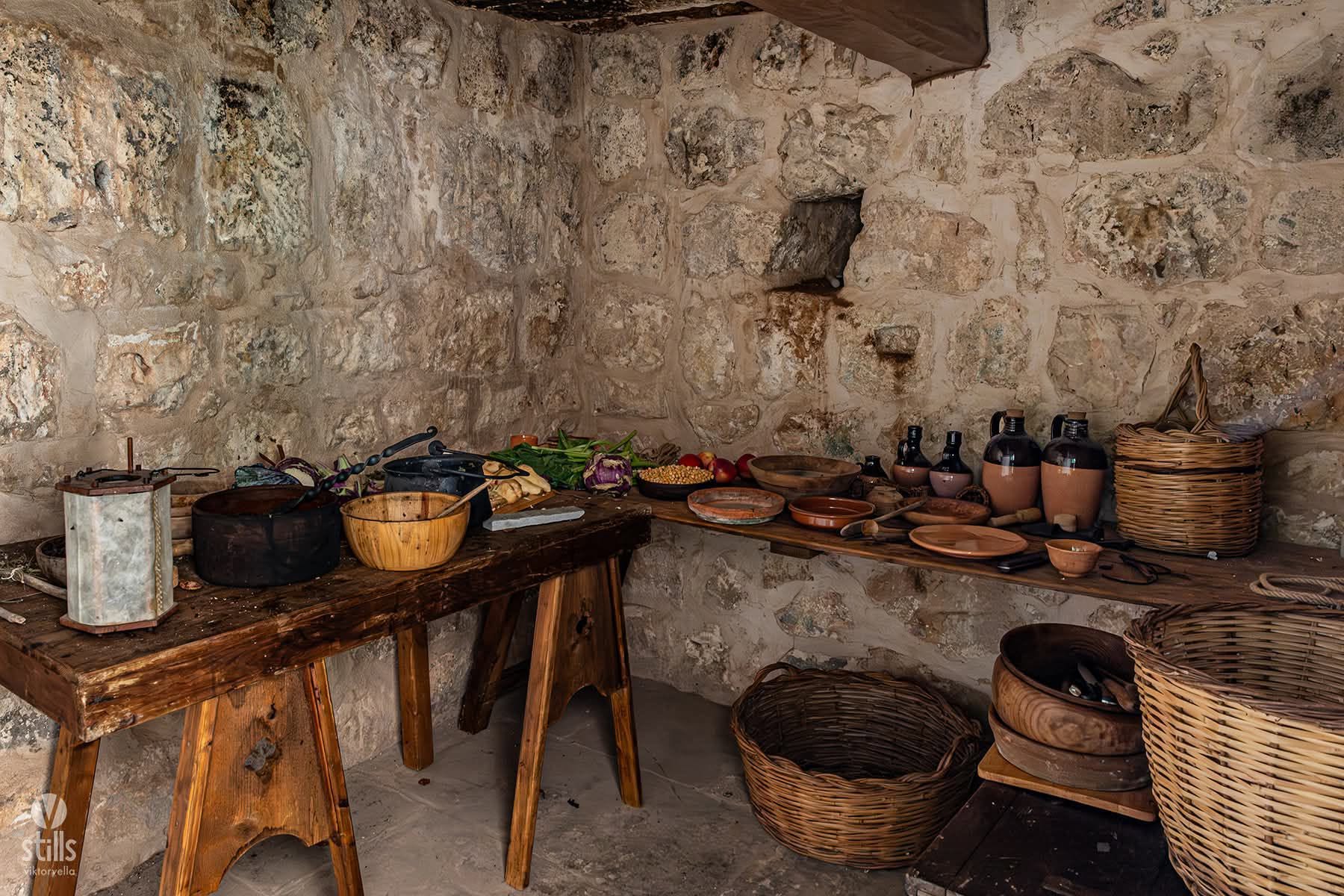
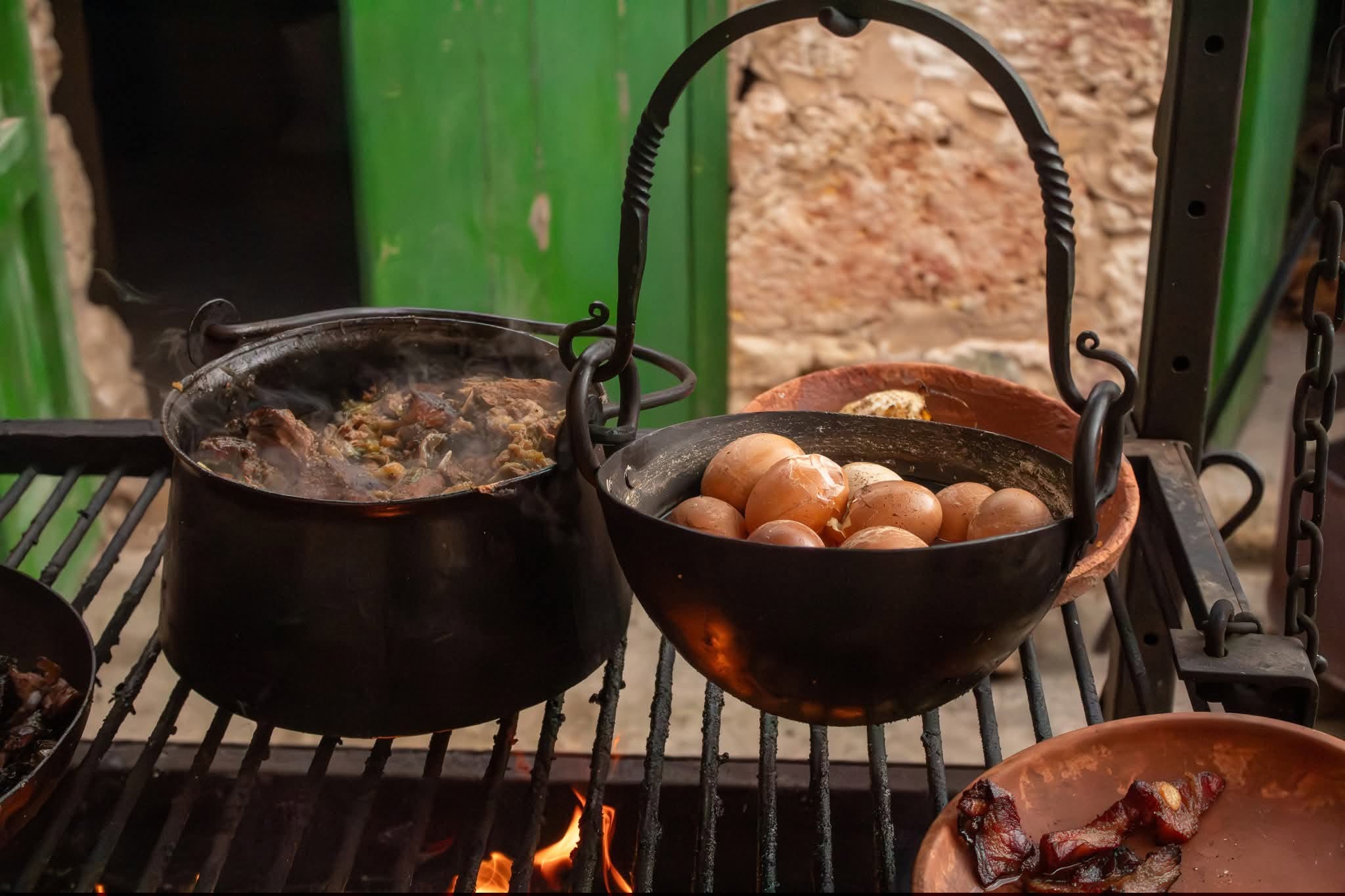
Before modern ovens and cookers, fire was at the centre of food preparation. Pots could be suspended above the flames, allowing food to be boiled or simmered while the distance from the fire helped control the heat. Other foods could be cooked in pans or roasted near the fire.
Large cooking vessels were especially useful for dishes in which several ingredients were prepared together. Across medieval Europe and the Mediterranean, broths, pottages and similar one-pot dishes could contain combinations of cereals, pulses, vegetables, herbs and, when available, meat.
We cannot assume that every European medieval recipe was eaten in Malta. The surviving Maltese evidence is too limited for that. Living-history cooking therefore demonstrates historically plausible techniques while distinguishing them from dishes that can be documented specifically in the Maltese Islands.
Bread, grain and Malta's connection with Sicily
Bread was a fundamental food in medieval Malta, but the grain needed to produce it was also one of the islands' greatest vulnerabilities.
Malta depended heavily on imported grain, particularly from Sicily. Obtaining adequate supplies became an important responsibility of the Università, the municipal authorities of Malta and Gozo. This meant that something as ordinary as bread was connected to shipping, trade and the political relationship between Malta and neighbouring Sicily.
Historian Carmel Cassar describes bread as a common element of the Maltese diet across different levels of society. George Cassar likewise identifies bread as a particularly important food and notes that the quality of bread could reflect social status, with wealthier people having access to finer wheat flour while poorer people consumed bread made from mixed grains.
Medieval Maltese food therefore cannot be understood only by looking at what grew locally. The islands formed part of a wider central Mediterranean economy in which food moved across the sea.
Meat, livestock, milk and cheese
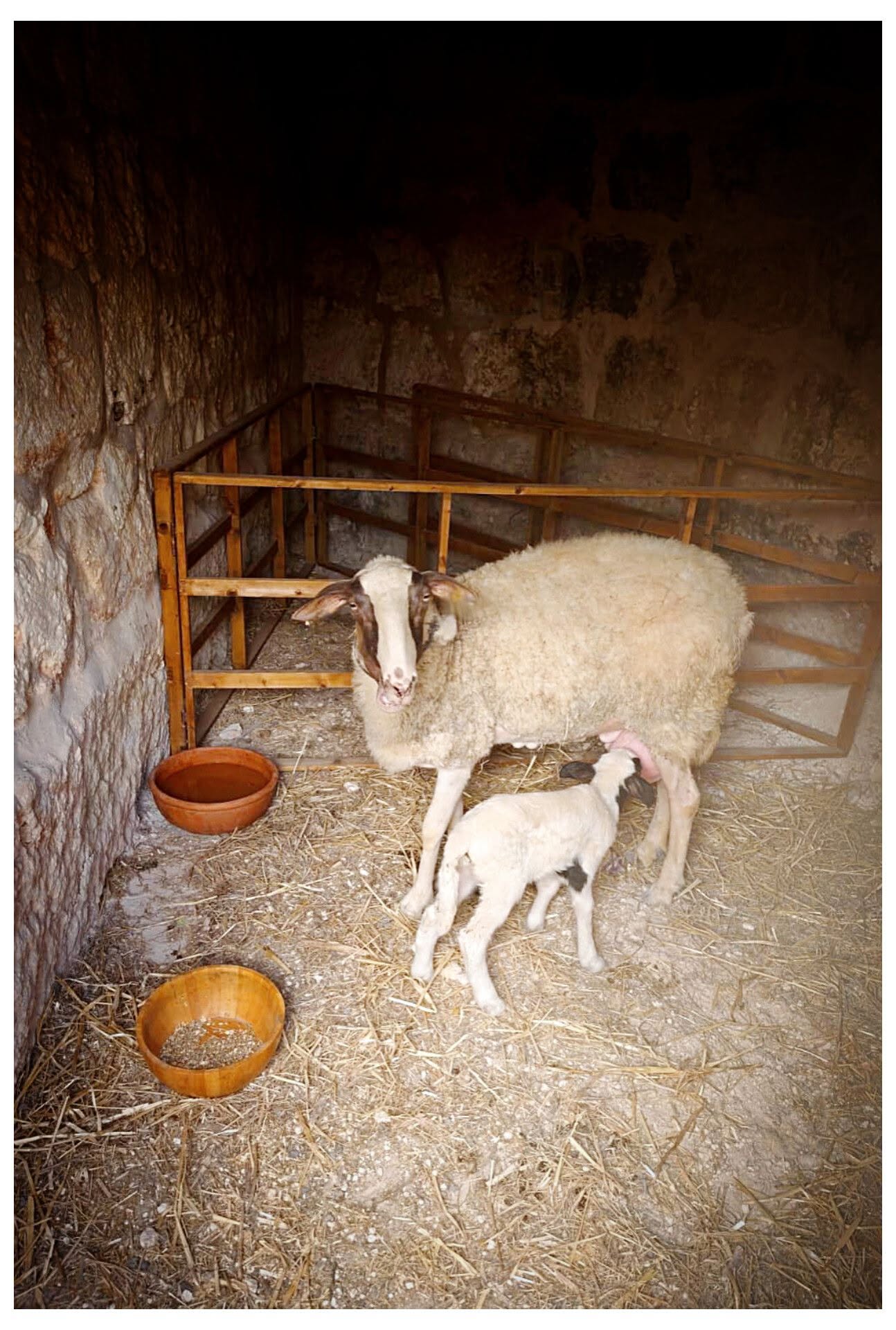
Animal husbandry was an important part of Malta's medieval economy. Large areas of the islands were better suited to grazing than to intensive cereal cultivation, making livestock particularly significant.
Surviving evidence indicates that milk and cheese were produced locally in considerable quantities, while honey was another important product. Meat was also eaten, although access to it would have varied according to wealth, occasion and availability.
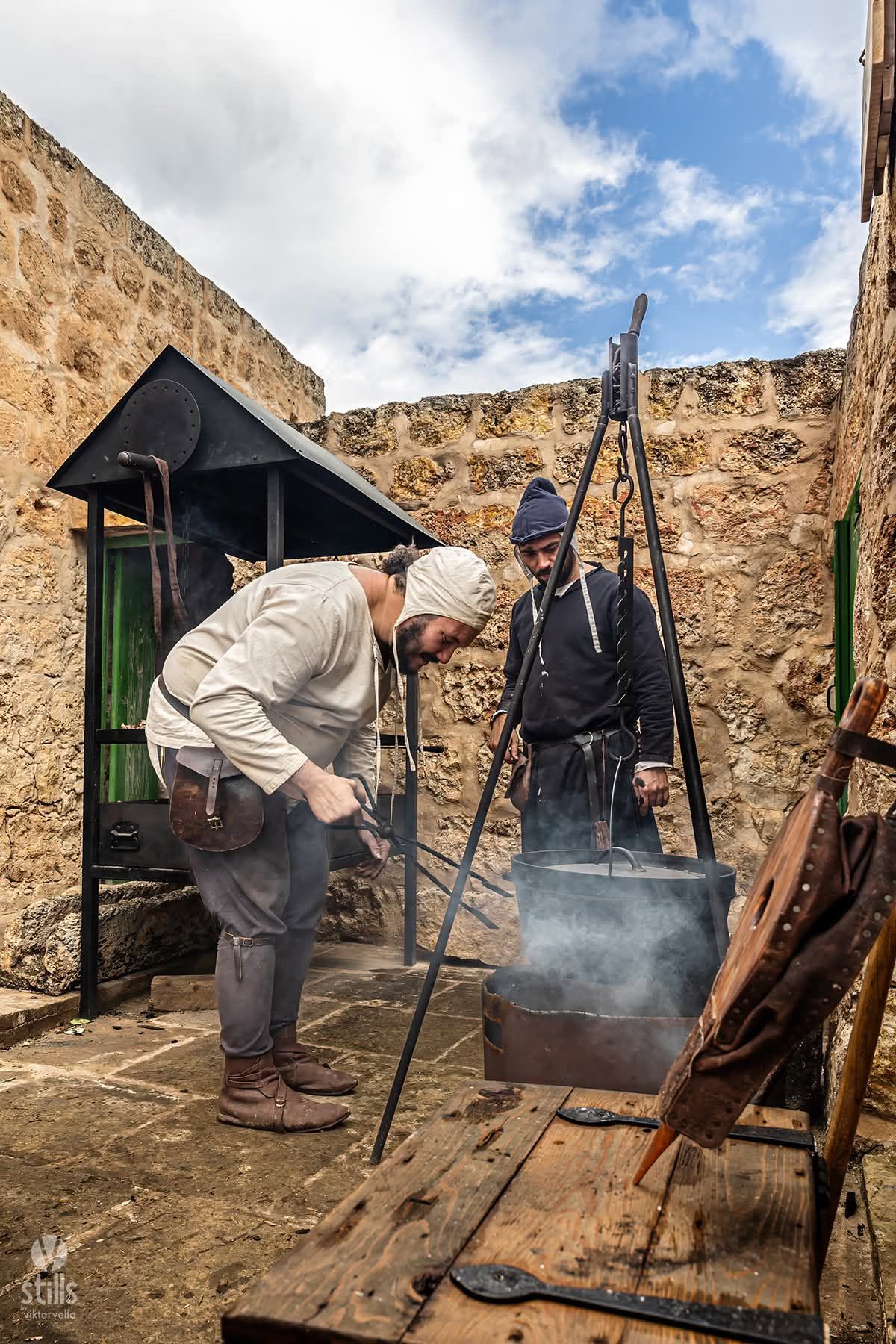
A large animal roasting over a fire should therefore not be interpreted as an ordinary daily meal for every medieval Maltese family. Livestock had value beyond meat: animals could provide milk, hides and other resources, and the diet of poorer households would generally have differed from that of wealthy residents.
Living-history demonstrations such as this allow visitors to examine a historical cooking technique while recognising that a spectacular roast does not represent the everyday diet of the entire population.
What might have been in the cooking pot?
Medieval Maltese food was not simply a diet of bread and roasted meat. Eggs, dairy products, vegetables, pulses, cereals, herbs and other locally available ingredients could all contribute to meals.
The difficulty is separating direct medieval evidence from information that survives only from later periods. Early-modern Maltese records frequently describe relatively modest food based heavily on bread, oil and vegetables. Historians use this evidence cautiously when considering the medieval period because eating habits among ordinary communities may have changed gradually rather than suddenly.
These later sources can therefore provide useful clues, but they do not prove that a specific fifteenth-century Maltese family ate a particular combination of foods on a particular day.
This distinction is central to living history. Where an ingredient or practice is documented, we can present it with confidence. Where evidence is incomplete, the reconstruction should be described as plausible rather than certain.
From historical evidence to living history
There is no surviving menu that tells us exactly what an ordinary Maltese household ate on a particular day in the fifteenth century. Instead, the surviving evidence gives us fragments of a larger picture.
We know that bread was fundamental, that Malta relied heavily on Sicily for grain, and that livestock, milk, cheese and honey formed part of the islands' food economy. We can also investigate the cooking equipment and techniques used across the medieval Mediterranean.
At Anakron Living History, our aim is not to present reconstructed dishes as unquestionable historical fact. We use documentary evidence, archaeology and comparative sources to explore what was documented, what was plausible and what remains uncertain.
Living history is most valuable when it does not hide those uncertainties. It allows us to take the surviving evidence and turn it into something that can be seen, handled, prepared and discussed.
Sources & further reading
- Cassar, Carmel. “Nutrition in a Central Mediterranean Island Community: Malta in Medieval and Early Modern Times.” Rivista di Antropologia, Vol. 76, 1998, pp. 153–162. University of Malta Open Access Repository. https://www.um.edu.mt/library/oar/handle/123456789/7321
- Cassar, Carmel. “Eating and Fasting in Medieval & Early Modern Malta.” Welcome: The Official Journal of the Institute of Tourism Studies, Vol. 1, 2008, pp. 21–29. University of Malta Open Access Repository. https://www.um.edu.mt/library/oar/handle/123456789/106373
- Cassar, George. What They Ate: Food and Foodways in Mdina and Beyond — From Roman Times to the Middle Ages. Heland Project, Malta, 2015. University of Malta Open Access Repository. https://www.um.edu.mt/library/oar/handle/123456789/19252
Last updated 2026-09-18
Explore more history →